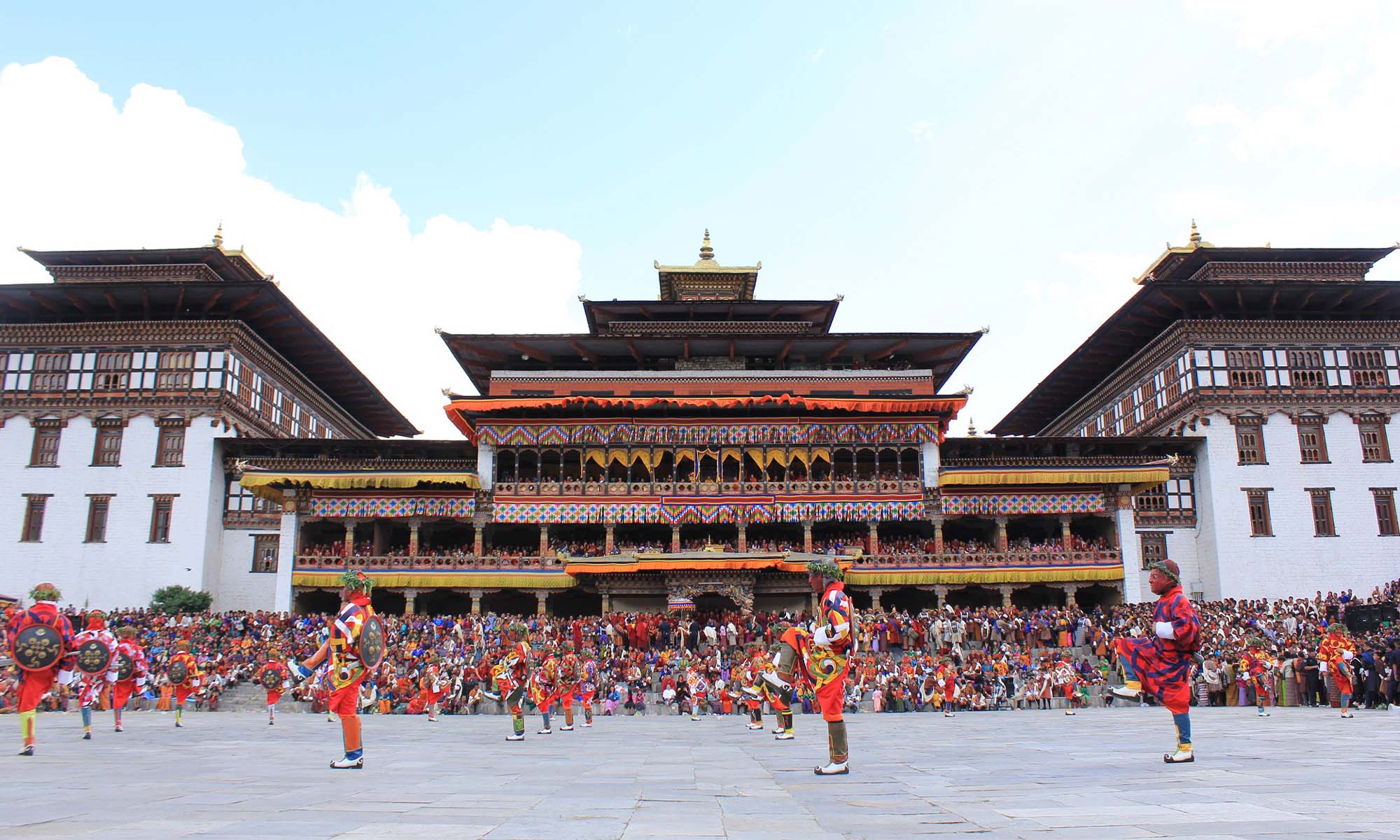
About Bhutan: culture, nature, and travel inspiration.
Bhutan, known in Dzongkha as Druk Yul, the Land of the Thunder Dragon, is a Himalayan kingdom between India and China where mountain valleys, forests, monasteries, and communities invite travellers to slow down and pay attention to place.
Druk Yul, the Land of the Thunder Dragon20 districts with Thimphu as capitalCulture, nature, spirituality, food, and history
Bhutan in Brief
A small kingdom with a powerful national identity.
Bhutan is known for Himalayan landscapes, living culture, protected forests, and a development philosophy rooted in wellbeing.
Name & Identity
Bhutan is often linked to the Sanskrit Bhota-anta, meaning the end or edge of Tibet. In Dzongkha, the country is Druk Yul, the Land of the Thunder Dragon.
Geography & Neighbours
Bhutan sits in the eastern Himalayas, bordered by China to the north and India to the west, south, and east. Its valleys and roads change markedly by altitude and weather.
Capital & Districts
The kingdom is divided into 20 dzongkhags, or districts, with Thimphu as the capital and main administrative, cultural, and economic center.
People & Languages
Dzongkha is the national language, English is widely used in education and tourism, and many regional languages and local traditions remain alive.
National Flag
A symbol of monarchy, faith, purity, and prosperity.
The Bhutanese flag is divided diagonally with a white dragon across the center. Its colors express the balance of secular leadership, spiritual heritage, loyalty, and national wellbeing.
Yellow
The upper yellow half represents the secular authority of the King and Bhutan's royal tradition.
Orange
The lower orange half represents Bhutan's spiritual heritage and Mahayana Buddhist practice.
White Dragon
The dragon represents purity, loyalty, national identity, and the protective strength of Bhutan's guardian deities.
Jewels
The jewels held by the dragon symbolize prosperity, wealth, perfection, and the wellbeing of the kingdom.
A Brief History
From sacred temples to a modern constitutional monarchy.
Bhutan's history is shaped by Buddhism, valley kingdoms, national unification, the Wangchuck dynasty, and the country's transition to constitutional democracy.
First Buddhist temples
Bhutan's recorded Buddhist history begins with temples such as Kyichu Lhakhang in Paro and Jambey Lhakhang in Bumthang.
Guru Rinpoche's spiritual legacy
Padmasambhava, known locally as Guru Rinpoche, introduced Tantric Buddhism and became one of Bhutan's most revered spiritual figures.
Zhabdrung unifies Bhutan
Zhabdrung Ngawang Namgyal unified warring valleys into Druk Yul and built dzongs for religious and administrative life.
Birth of the hereditary monarchy
Ugyen Wangchuck was unanimously chosen as Bhutan's first hereditary king by leading monks, officials, and influential families.
Bhutan joins the United Nations
Under the Third King, Bhutan began modern reforms and development planning and joined the United Nations.
The Fifth King begins his reign
Jigme Khesar Namgyel Wangchuck became Bhutan's fifth king, continuing the country's modern transition.
Constitutional democracy
Bhutan adopted its constitution and held parliamentary elections, becoming a democratic constitutional monarchy.
Nature, People & Daily Life
The deeper layers that make Bhutan unique.
Bhutan is rich in forests, wildlife, languages, food, faith, crafts, customs, and mountain travel experiences, with local variation from valley to valley.
Flora
Forests, flowers, and medicinal plants
Because Bhutan rises from subtropical foothills to alpine highlands, its plant life is exceptionally diverse.
- Forest types include fir, mixed conifer, blue pine, chir pine, broadleaf-conifer, upland hardwood, lowland hardwood, and tropical lowland forests.
- Bhutan has about 300 species of medicinal plants and around 52 species of rhododendrons.
- Visitors may see magnolia, juniper, orchids, gentian, giant rhubarb, oak, pine, and the blue poppy.
Fauna
Wildlife from snow leopards to black-necked cranes
Bhutan's forests, rivers, valleys, and high mountains support rare mammals and important bird habitats.
- High-altitude species include snow leopard, red panda, blue sheep, musk deer, Himalayan black bear, and langur.
- Southern forests support clouded leopard, elephant, water buffalo, swamp deer, one-horned rhinoceros, and golden langur.
- Phobjikha and Bomdeling are important winter habitats for the endangered black-necked crane.
Religion
A spiritual country in daily practice
Religion is woven into Bhutanese identity, public life, family life, festivals, architecture, and everyday routines.
- Buddhist temples, monasteries, prayer flags, prayer wheels, and chortens are visible across the country.
- Buddhism was introduced in the 7th century and strengthened by Guru Rinpoche in the 8th century.
- Hinduism, older animistic beliefs, nature worship, omens, and local rituals also form part of Bhutan's spiritual landscape.
People
Communities, dialects, and identity
Bhutan's people are culturally and linguistically diverse, shaped by geography, valleys, migration, and history.
- The Ngalops are associated mainly with western Bhutan and the Dzongkha-speaking cultural world.
- The Sharchops are associated mainly with eastern Bhutan and strong Nyingmapa Buddhist influences.
- English is widely used in education, while many regional dialects remain alive.
Wellbeing
Gross National Happiness
Bhutan's development story is guided by a policy framework that values wellbeing alongside economic progress.
- Gross National Happiness connects development with sustainable socioeconomic progress, environmental conservation, cultural preservation, and good governance.
- The framework also considers nine areas of wellbeing, including health, education, community, time use, and living standards.
- Visitors experience this through slower travel, community encounters, protected landscapes, and meaningful interpretation.
- GNH is a policy approach and travel context, not a promise that every person is always happy.
Regions
Western and Central Bhutan
Bhutan's valleys have distinct identities, languages, landscapes, and ways of life.
- Western Bhutan includes rice paddies, orchards, Dzongkha-speaking communities, and major cultural centers.
- Haa's climate is especially suited to livestock raising.
- The Black Mountains traditionally mark the boundary between western and central Bhutan.
Landscapes & Flora
From subtropical foothills to alpine highlands.
Bhutan's dramatic altitude range creates extraordinary ecological diversity, from tropical lowland forests to temperate valleys and high alpine zones above the tree line.
Subtropical Zone
Approx. 150-2,000mWarm southern and lower valley areas with tropical vegetation, lowland hardwood forests, rivers, and rich wildlife habitats.
Temperate Zone
Approx. 2,000-4,000mConifer forests, broadleaf forests, rice valleys, orchards, blue pine, mixed conifer, upland hardwood, and major cultural towns.
Alpine Zone
Approx. 4,000m+High mountain landscapes above the main forest line, with alpine terrain, high passes, yak herder areas, and snow-capped Himalayan peaks.

Cuisine
Spice, red rice, cheese, tea, and local hospitality.
Bhutanese food is simple, hearty, spicy, and strongly connected to farming, altitude, family meals, and social customs.
Staple Foods
Bhutanese meals are filling, local, and often spicy, with rice, buckwheat, maize, dairy, and chillies playing a major role.
Red riceBuckwheatMaizeYak cheeseCow cheeseChillies
Signature Dishes
Ema datshi, a chilli-and-cheese dish, is one of the most recognizable Bhutanese foods.
Ema datshiMeat soupsCurriesDried chilliesFarmhouse meals
Tea & Local Drinks
Tea and local drinks are part of hospitality, ceremonies, and social gatherings across Bhutan.
NgajaSujaAraRed Panda beerDruk LagerLocal spirits
Social Customs
Doma, or betel nut with leaf, is traditionally offered as a gesture of greeting and social connection.
DomaHospitalityCeremonial offeringCommunity gatherings
Flying to Bhutan
Arriving in the Kingdom in the Clouds is part of the experience.
Flying into Bhutan offers views of Himalayan peaks, forested valleys, glacier-fed rivers, and traditional architecture. Flight routes, schedules, and arrival airports should be checked before finalising dates.
International Gateway
Paro remains the best-known international gateway, while official Bhutan travel guidance also lists Gelephu among the country's international airports.
Airlines
Drukair and Bhutan Airlines operate international services to Bhutan. Compare current routes, prices, baggage rules, and arrival airports on official airline channels.
Domestic Airports
Domestic airports can support longer routes to central, eastern, and southern Bhutan, subject to schedules, weather, and operational availability.
Mountain Aviation
Because of Bhutan's terrain, flights are specialized and pilots require training for Paro's unique conditions.
Enter Bhutan by Land
Travelers can also enter Bhutan through official land entry points at Phuentsholing, Gelephu, and Samdrup Jongkhar.
Combined Overview
The older Bhutan overview content is still here.
Discover Bhutan now gathers the introduction, useful facts, reasons to visit, culture notes, seasons, and destination choices into one clearer overview path.
Why visit Bhutan
The travel-inspiration content remains available for guests choosing between culture, nature, soft adventure, and slower journeys.
Open Why Visit BhutanBhutan facts
Quick national facts, symbols, environment notes, and memorable details are still available for visitors who want a concise reference.
Open Bhutan FactsCulture and GNH
History, monarchy, food, living traditions, and Gross National Happiness are combined under Culture and Heritage.
Open Culture and HeritageValleys and route ideas
Destination content is organized around Paro, Thimphu, Punakha, Wangdue, Phobjikha, and Haa to help visitors choose a route.
Open Places to VisitBhutan Through Images
A visual glimpse of the kingdom.
Festivals, dzongs, valleys, monasteries, and mountain light are part of the Bhutan travel experience.